The Power of Film to Spread Message & Raise Awareness
Author: Chutema Seng | Posted on February 14, 2022
 |  |  |  |
|---|---|---|---|
 |
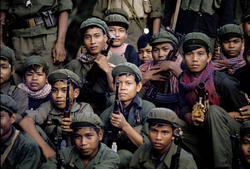
Film has the power to send a powerful message to the viewers. The "First They Killed My Father" movie was one of the most famous films in Cambodia. It reflects deeply and drastically how the situation on April 17, 1975, has transitioned Cambodia into the worst political regime revolution and the most agonizing event in history. The main message from the director of this movie is to raise awareness about this painful and unforgettable genocide era in Cambodia. It is to bring a great impact and show to all the audience around the world and especially leaders that this action is beyond unacceptable and that something like this should not happen ever again.
Our fellow classmate, Rath Sereiwoody, has also shared a very similar point of view about this topic as well, which is the importance of storytelling. He stated that “Stories are compiled together and used to amplify and reflect the dark past of Cambodia to the younger generations. Those movies and stories aim to spread the experiences of Khmer Rouge victims while expecting to learn about this sad and sorrowful nostalgia and probably hoping that, we the audience or the younger would be touched enough to do something about it so that it will not happen again".
He also added that “The voice is used as a mirror to reflect what happened in the past, in the hope their story would impact on today’s society and prevent something like this from happening again. It’s more than storytelling, but it’s a movement of voice seeking to be heard of, a movement seeking for justice, and a movement to prevent such a regime from happening again”.
In the film, there were many scenes that depict the real trauma and experience of the young survivor named Luong. Her starvation, fear, and anxiousness to endure this traumatizing event were beyond words. Luong has gone through dreadful situations where those Angka killed her father, her family was separated, and soldiers even recruited her to be in the war fields. Imagine at such a young age, she had to experience all of these.
Besides, the book “Children of the Killing Fields: Memoir of Survivors” depicts many victims' experiences during the regime as well. However, the contents are more verbally written and expressive. The victims described words by words about how they felt and encountered during the regime. The nightmare, killing, anxiety, and pain of losing their loved ones, some starve to death and some were forced to work until there is no more tomorrow. As we can see, the reason that I believe the book is more expressive than film is that the book clearly narrated different experiences of each victim’s speech and intellect. Whereas the film, Luong did not say such words, however, the director expressed her feelings and anxiousness through her dreams and imagination instead.
Due to these tragic and dramatic events, when we hear Khmer Rouge, a lot of people would think of it as an armed conflict, the regime of extreme mass killing fields, 1.7 million people were killed, genocide and violence. On the other hand, Pol Pot and his followers view it as a distinct movement to protect the nation from Vietnam's destruction. Pol Pot even claimed that their crime was partly disguised behind the banner of their extreme Nationalism, which is their deep nationalistic sentiment to protect the country. Their ideology was characterized by the efforts to create nationalism which is the survival of the Cambodian state, due to many appalling occasions during the period of French colonization and followed by Vietnam’s attempts to dominate in Southeast Asia. Like the Khmer Republic controlled by Lun Nol before, Khmer Rouge made the Vietnamese become the main target of this regime’s extreme brand of nationalism, which resulted in this mass killing fields and genocide era. Khmer Rouge defines people who have a voice or concern as “traitors” or “Khmer bodies with Vietnamese mind”. It is a broad category of the Cambodian population who do not accept Khmer Rouge leadership in an anti-Vietnamese crusade. Due to the massive Khmer Rouge brutality in the repression of Cambodia treason has resulted in a genocide era.
Even though the Khmer Republic authorities and the Khmer Rouge Regime were enemies and have different ideology views, I believed that they shared the same view and belief against the Vietnamese communist party as the threat to the Cambodian Sovereignty by defining them as “Yuon Invader”, which is Vietnam Invader. Khmer Rouge's attempt is to create a classless society, money was abolished, capitalism, private property, formal education, religion, and traditional cultural practices. This repressive regime denied all basic civil rights and freedoms.

As we can see in the film “First They Killed My father”, Luong saw everyone put down what they are carrying and even money as Angka told. Angka proudly announces that “They reject everything that was part of the imperialist and feudalist society. You don’t need money. In the new Cambodia, there will be no banking, no trading, and no private property. No rich, no poor, no class. We all the same now”.
